Introduction
If you have ever stood in a crowd and thought “this is grand” or “this is getting a bit much”, you have made a Level of Service judgement without knowing it. Level of Service is the scale that turns that gut feeling into something we can plan around. It is one of the most useful ideas in Crowd Safety, and most event organisers have never heard of it.
We touched on density in our free How Many People Fit email course, where two people per square metre is the usual starting point for a standing crowd. Level of Service is the framework that sits underneath that number and explains why the same square metre can feel comfortable at one event and dangerous at another.
This article explains what Level of Service is, where it comes from, and how we use it when we decide how many people safely fit at an event.
Where Level of Service Comes From
The concept goes back to John Fruin, an American engineer who studied how people move on foot. His 1971 book, Pedestrian Planning and Design, gave us a way of grading crowd conditions from open and free-flowing through to packed and barely moving. Prof. Dr. G. Keith Still, whose work we draw on regularly, has done a lot to make the idea usable for events rather than just for transport hubs.
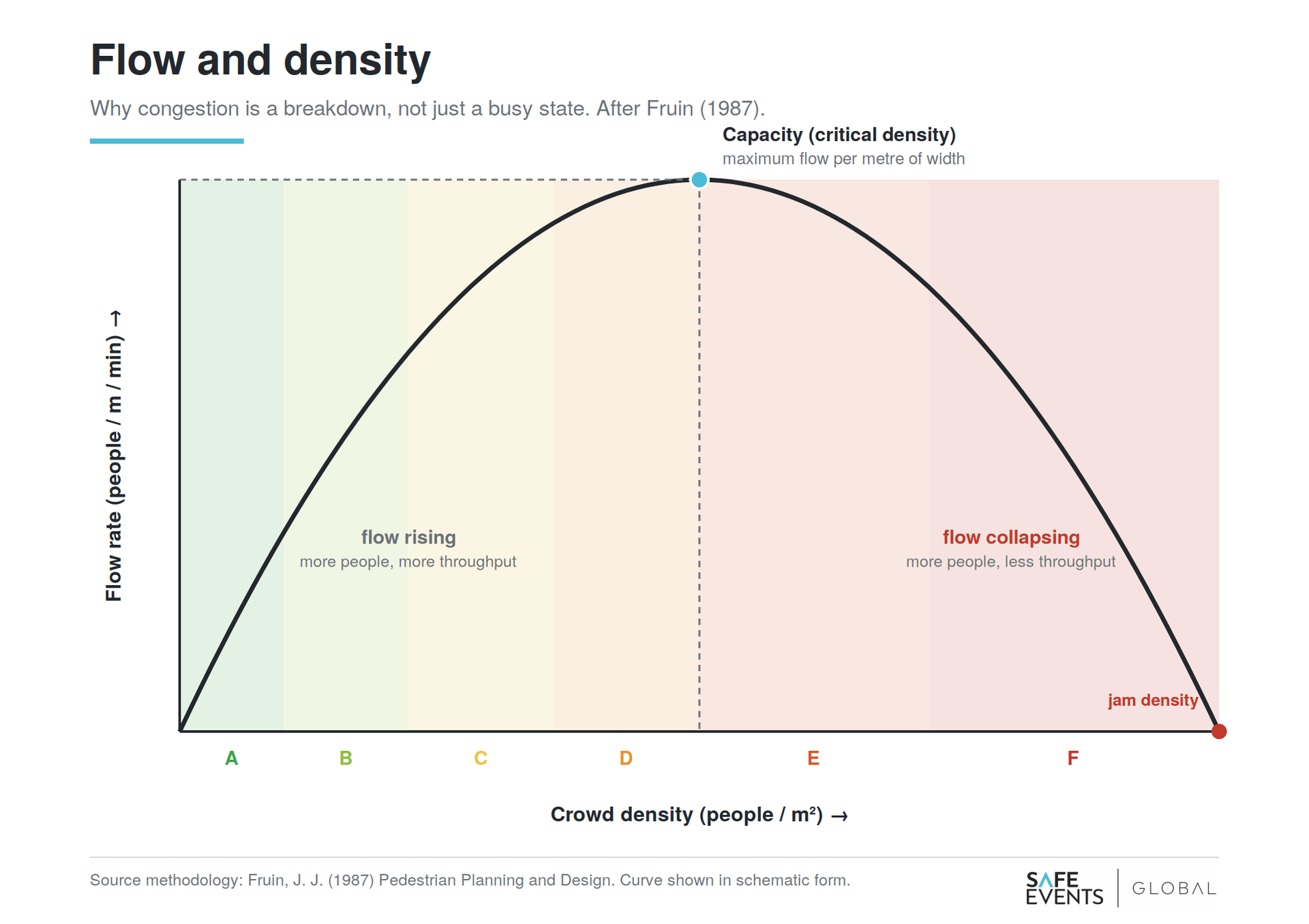
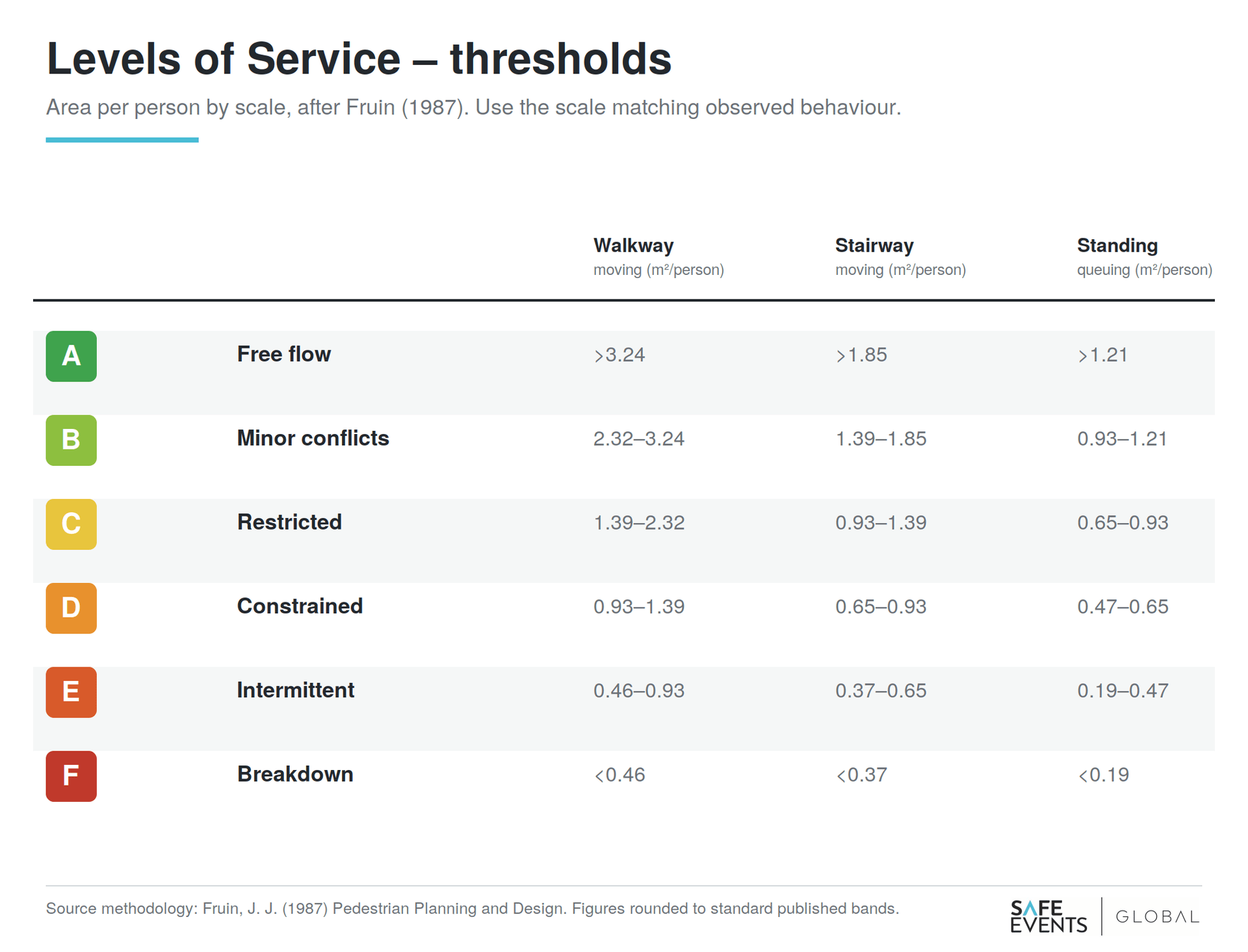
Fruin’s original scale runs from A to F, a bit like a school report. Level A is wide-open space where people walk wherever they like. Level F is the dense, shuffling crowd where movement is dictated entirely by the people around you. The letters describe how it feels to be in that crowd, and what that means for how the crowd will behave.
Fruin measured space as area per person, which most people find hard to picture. We follow the simpler convention Keith Still recommends and talk in people per square metre instead. It is easier to visualise and it keeps everyone in the room speaking the same language.
The bands, in plain terms
Without drowning you in figures, the progression looks roughly like this:
- Comfortable (around A to C): people move freely, choose their own path, and pass each other without contact. Below roughly one to two people per square metre.
- Restricted (around D to E): movement slows, people start to adjust their pace to others, and personal space disappears. This is where most busy standing events sit.
- Critical (F): above the critical density of roughly two to three people per square metre, flow starts to break down. People move as a mass, not as individuals. This is where the risk lives.
Worth saying clearly: the exact density where flow breaks down is not a fixed number. It shifts with the crowd, the surface, the slope, and what people are trying to do. A truth we have learned the hard way is that the same density behaves very differently at a family event than at a rail of hardcore fans.
We look at why in our follow-up piece, Crowd Types: Why the Same Density Feels Different. It covers how families, fans and moving crowds use space, and why comfort shifts with who is in the crowd.
Why Comfort Is a Safety Question
It is tempting to file Level of Service under “customer experience” and move on. That would be a mistake. The point where a crowd stops being comfortable is closely related to the point where it stops being safe.
As density climbs past the critical point, two things happen at once. Flow rate drops, so people leave the space more slowly exactly when you might need them to move faster. And the crowd loses the ability to self-organise, because nobody can choose their own path any more. Pressure builds, and small problems propagate through the crowd instead of staying local.
This is why we care about Level of Service when we run the four capacity calculations covered in the course. A holding capacity that looks fine at two people per square metre can be the wrong answer if the way people actually use the space pushes parts of it into Level F. The headline number is only as good as the comfort level it assumes.
How We Use Level of Service in Practice
Level of Service is not an academic curiosity for us. It feeds directly into how we plan and how we monitor on the day.
In the design phase
When we are building a site or advising on a layout, we are choosing a target Level of Service for each area. A thoroughfare needs to stay free-flowing, so we design it for a comfortable band and a generous width. A front-of-stage pen will run denser by its nature, so we plan for that, build in relief, and make sure the exits and the response can cope. Setting the target early is a core part of a good Crowd Safety approach, and it ties straight back to the first-pass thinking we teach in the course.
In the Risk Assessment
Density is one of the hazards we assess directly. A good Risk Assessment looks past whether a space is over capacity in total. It asks where the pinch points are, what Level of Service those points will reach at peak, and what happens if something changes. A blocked route or a popular act can tip an otherwise comfortable area into a critical one in minutes.
On the day
Live, our teams are reading Level of Service constantly, whether they name it or not. Crowd-counting tools, CCTV, grid references, and experienced eyes all feed the same question: is this area still in the band we planned for? When it drifts, we act before it tips. That monitoring role is exactly what separates an assessed capacity from a number on a page.
A Word on the Front of Stage
The course makes the point that the very front of a show will routinely run denser than the rest of the room, often around four people per square metre and sometimes higher. In Level of Service terms, that front rail is sitting firmly in Level F, by design and by choice.
People who want to be at the barrier accept they will be packed tighter than those at the back. That is fine, up to a point, provided we have planned for it: the right barrier, the right number of pen breaks, a viewing-pen structure that lets pressure release, and a response team watching for the signs. The density itself is not the problem. An unplanned, unmonitored density is.
Bringing It Together
Level of Service gives us a shared language for something that used to live only in experienced people’s gut feeling. It turns “this feels too tight” into a target we can design for, a hazard we can assess, and a condition we can monitor.
It also explains why deciding how many people fit is genuinely complex work. The same square metre is comfortable, restricted, or critical depending on who is in it and what they are doing. Getting that judgement right is a key part of what we deliver for clients, and it is why we are firm that capacities should be set by experienced Crowd and Event Safety professionals. If you would like to talk through capacities for your own event, get in touch.
Frequently Asked Questions
What is Level of Service in crowd safety?
Level of Service is a scale, originally developed by John Fruin, that grades crowd conditions from open and free-flowing to densely packed. It links crowd density to how comfortable and how safe a crowd is. Crowd Safety professionals use it to set targets when designing event spaces and to judge conditions during an event.
How does Level of Service relate to people per square metre?
Density is the main driver of Level of Service. Lower densities, below roughly one to two people per square metre, sit in the comfortable bands where people move freely. As density rises past the critical point of around two to three people per square metre, conditions move into the restricted and critical bands where flow breaks down.
Is a high Level of Service good or bad?
It is the other way around from what the name suggests. Level A is the best condition, with the most space and freedom of movement, while Level F is the most crowded and the highest risk. So a “high” letter actually means a worse, denser condition. This is a common source of confusion.
Can a high-density area ever be safe?
Yes, if it is planned and monitored for. A front-of-stage pen routinely runs at a dense Level of Service and can be operated safely with the right barrier, viewing-pen design, and a response team watching for problems. The danger comes from density that has not been planned for or is not being watched.
Who should decide the Level of Service for an event?
Setting target densities and assessing how a space will perform is specialist work. It should be done by experienced Crowd and Event Safety professionals as part of the capacity assessment, not left to a rough rule of thumb. It draws on Risk Assessment, knowledge of the specific crowd, and live monitoring on the day.
Related Content
Is Crowd Safety the Same as Crowd Management?
Crowd Types: Why the Same Density Feels Different