Introduction
We shared our recent piece on Level of Service on LinkedIn and some useful comments came back.
Eric Stuart QPM, Director of Gentian Events, pointed out that people often take a density figure as a literal, non-negotiable number. They do not stop to think about who those people are. Four people per square metre of teenage boy band fans looks very different to hard rock fans at that density. He is right.
I had this article roughly started already, but figured it was worth finishing and publishing to accompany the LoS one.
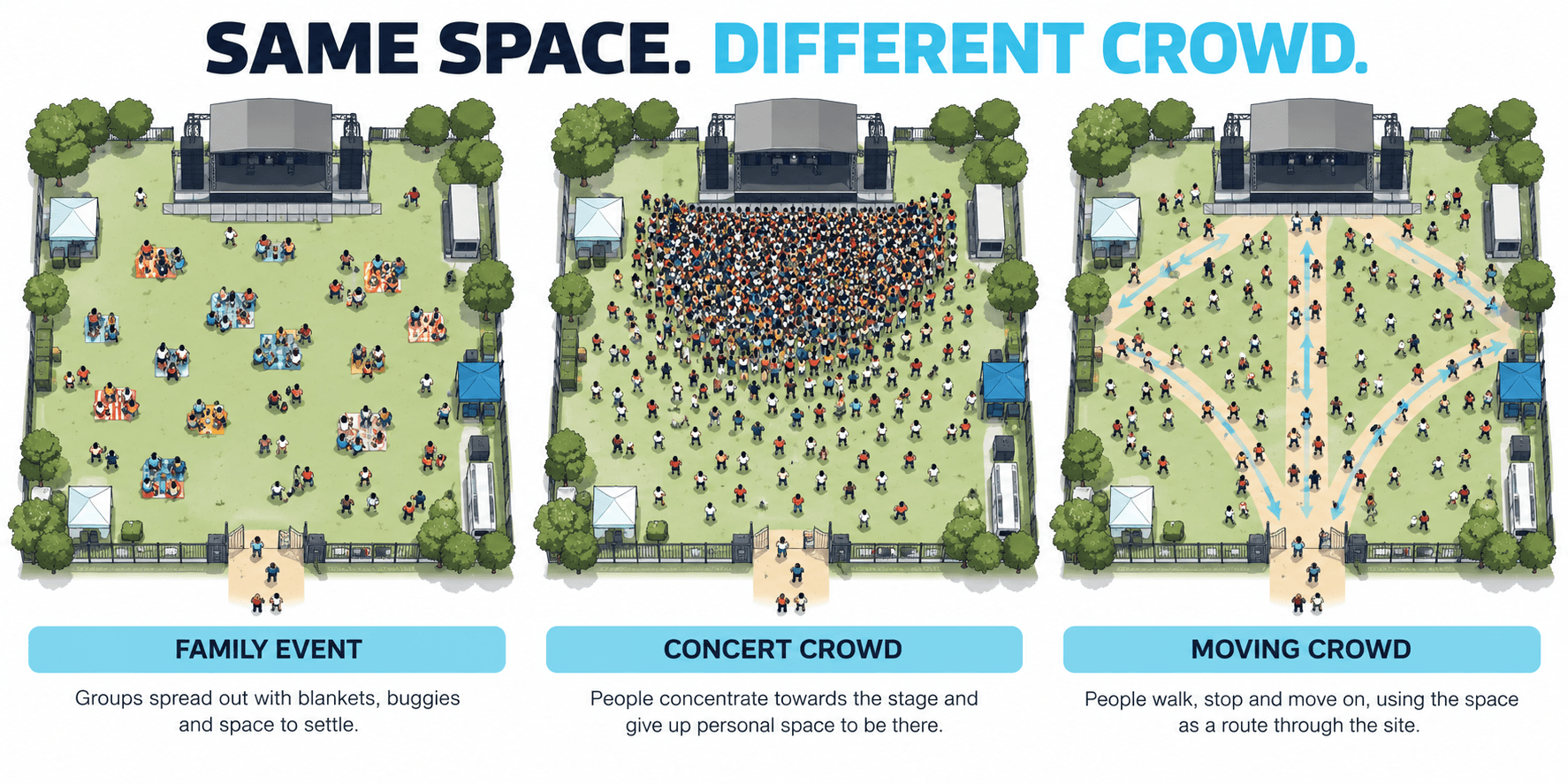
My reply to Eric on LinkedIn described the difference in terms of space. At a family event in a park, people spread out with buggies and picnic blankets on the ground. Hold a rock festival in the same park and the crowd uses that ground in a completely different way.
We touched on this briefly in the Level of Service piece. The bands on that scale describe how a crowd behaves as it gets denser. Who is in the crowd decides where on the scale people will be comfortable.
Planning Density and Crowd Type
Capacity work usually starts with a planning density. In our free How Many People Fit email course, two people per square metre is the usual starting point for a standing crowd.
That figure assumes people are standing, and plenty of crowds are not. A family picnic and a headline rock set on the same site plan will use the ground very differently.
At a family event, people arrive in groups. They put a blanket down beside the buggy and stay put for the afternoon. Children wander off and get called back. Each group holds its own patch of ground and notices quickly when someone sets up too close.
A good part of a rock festival crowd wants to be near the stage and in among other fans. They will give up personal space to get there. Some will spend the whole set closer to strangers than they would tolerate on a busy train.
How Different Crowd Types Use Space
For capacity work, we group crowd types by how they use space.
Settled crowds
A settled crowd claims space group by group. A family with a blanket and a buggy can take up several square metres between them, and squeezing another family into the gap causes friction.
All of that comes off your usable area, on top of the infrastructure. It also slows things down in an emergency. People who are sitting have to get up and gather children before they can walk anywhere.
Families also get uneasy at densities a festival crowd would barely notice. In our experience, the first sign is usually groups at the edges packing up and heading home early.
Fans at the front
Fan crowds sort themselves. Those who want density head for the front, while the rest hang back near the front of house position maybe or the bars. As we said in the Level of Service piece, the front of a show can routinely run at around four people per square metre. That puts the front rail in Level F by the audience’s own choice.
Averaged across the field, density can look fine while the front-of-stage area is in the critical band.
Eric’s boy band example matters here.
A young pop audience packs as tightly as a rock crowd, but smaller, younger people at a barrier are more exposed to the pressure. They can also see less of what is happening around them. We plan a young pop audience’s front-of-stage area differently from a rock crowd’s, even at the same density.
Moving crowds
Some crowds never settle.
On a parade route or a lantern trail, people walk, stop and move on. Space use here is about flow and pinch points. People need room to pass each other, which brings the comfortable density down again.
Moving crowds change character along the way, too.
On Dublin Pride, we plan for spectators lining the streets with small children at the kerb. We also plan for groups heading to the party at the finale site. Many people do both.
Most events of any size end up with more than one of these crowd types. A daytime family programme can turn into an evening headline show on the same field. Aberdeen City Council’s crowd profile guidance makes the same point from the licensing side. It notes that adding alcohol, or a band known for mosh pits, changes the risk profile of a familiar event.
Why Comfort Depends on Who Is Around You
Much of the research behind this comes from Prof. John Drury and colleagues at the University of Sussex. We cover the wider background in our piece on crowd psychology.
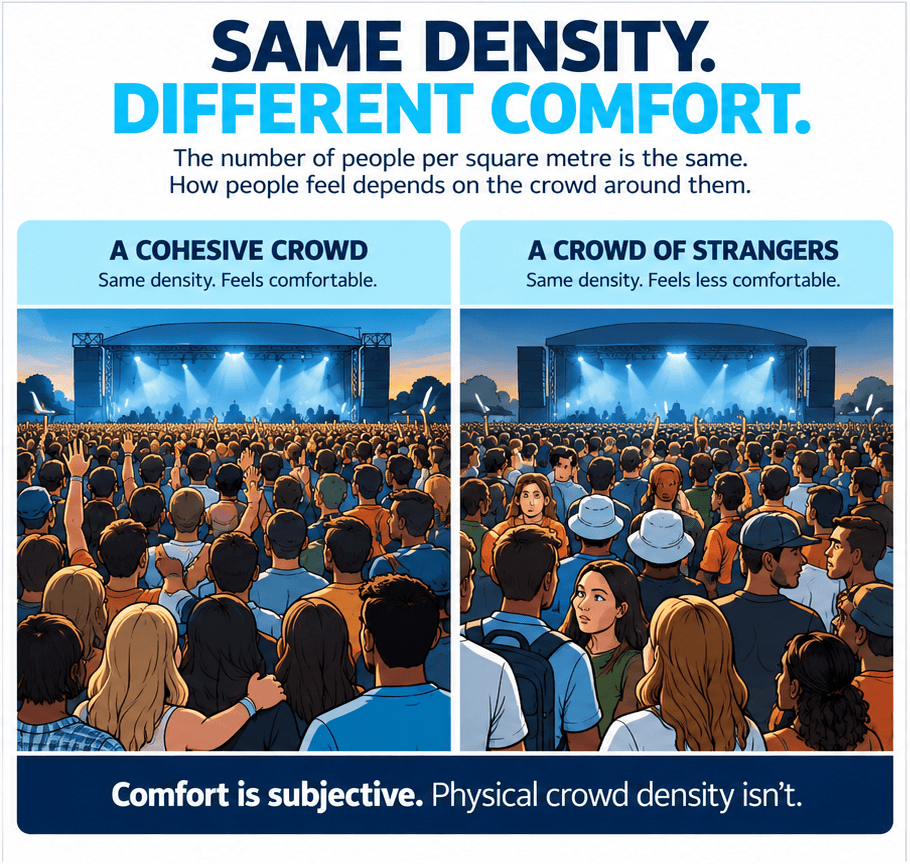
In two experiments published in 2010, David Novelli, John Drury and Stephen Reicher looked at where people chose to sit. People placed themselves closer to someone from their own group than to an outsider. Their personal space shrank when they shared an identity with the other person.
The team then tested the idea at real events.
They surveyed people who had been at a free beach party in Brighton in 2002. It was planned for around 65,000 people and drew an estimated 250,000. The more people identified with the crowd, the less crowded they said they felt. At a protest march in London, the strongest identifiers were in the densest part of the crowd (Novelli et al., 2013).
Hani Alnabulsi and John Drury found something similar at the Hajj. They surveyed pilgrims in the Holy Mosque in Mecca. Those who identified weakly with the crowd felt less safe as density rose. Strong identifiers reported feeling safer as it got denser.
For us, this explains a lot of what we see on site.
Comfort is not a safety limit
A close-knit fan crowd that is completely at ease can still reach crush conditions.
The Hajj research suggests people expect more support from each other when they identify with the crowd, and that helps. Even so, a crowd that is enjoying itself can show fewer of the early warning signs we watch for.
Planning for Crowd Types in Practice
The crowd profile shapes most of our capacity work:
- Density by zone: we set planning densities area by area, for the crowd expected in each. A picnic lawn and a front-of-stage pen can carry very different figures on one site. We see colleagues / competitors doing everything at 2 people per square metre, which we think doesn’t look at most situations deeply enough. In a recent piece of capacity work we did for a stadium, we estimated 10% of the crowd being at 3 people per square metre, 70% at 2 people per square metre and 20% at 1 person per square metre. We feel it’s more realistic.
- Usable area: the ground that seated family groups take up comes off the usable area, on top of the infrastructure.
- Exit flow: some audiences move more slowly. For example, Stockton-on-Tees Borough Council’s event planning guidance suggests cutting the assumed exit flow rate from 82 to 75 people per metre per minute for older audiences.
- Time of day: where the programme changes the audience, we assess each phase separately, including the changeover between them.
- Monitoring: teams get briefed on what discomfort looks like for each crowd on site. Families tend to drift to the edges. At a barrier, look for waving and people being lifted out.
All of this feeds into the Risk Assessment, alongside the site and the programme. When clients ask us to assess a capacity through our Crowd Safety service, audience profile is one of our first questions.
Bringing It Together
The Level of Service bands still apply to every crowd. What crowd types add is where people will settle by choice, and how fast they will show you they are unhappy. A committed fan crowd at the barrier sits at the dense end of the scale, and barrier design and monitoring need to match.
As I put it in my reply to Eric, this can only ever be so much of a science. There is an art to it too, and that is where experienced crowd safety eyes come in.
If you are planning an event and are unsure of the audience profile, we have argued before that professionals should decide your event capacity. Get in touch and we can talk through who is coming to yours.
Frequently Asked Questions
What are the main crowd types at events?
There is no single agreed list. Academic classifications exist, such as Berlonghi’s spectator, demonstrator and escaping crowds. For capacity work, we often group crowds by how they use space, for instance settled groups who claim ground, fans who seek density near the stage, and crowds on the move.
Why does the same crowd density feel different at different events?
Comfort depends heavily on who you are with. Research from the University of Sussex found that people who identify with the crowd around them feel less crowded at the same density, and some seek out the densest areas. A crowd of strangers at that density will usually feel far less comfortable.
Does a comfortable crowd mean a safe crowd?
No. A happy crowd can still reach densities where people can no longer move freely. Planning limits have to come from the space and the exits.
How much space does a family audience need at an event?
It depends on how they will use the site. Families who sit down on the ground need considerably more room than a standing crowd, and become uncomfortable at lower densities. The right figure should come from an assessment of that specific event by someone experienced in Crowd and Event Safety.
How do crowd types affect emergency evacuation?
Some crowd types take longer to get moving and walk more slowly once they do. Seated groups take time to get up, and some guidance suggests lower exit flow rates for older audiences. These factors belong in the emergency exit calculation from the start.