Introduction
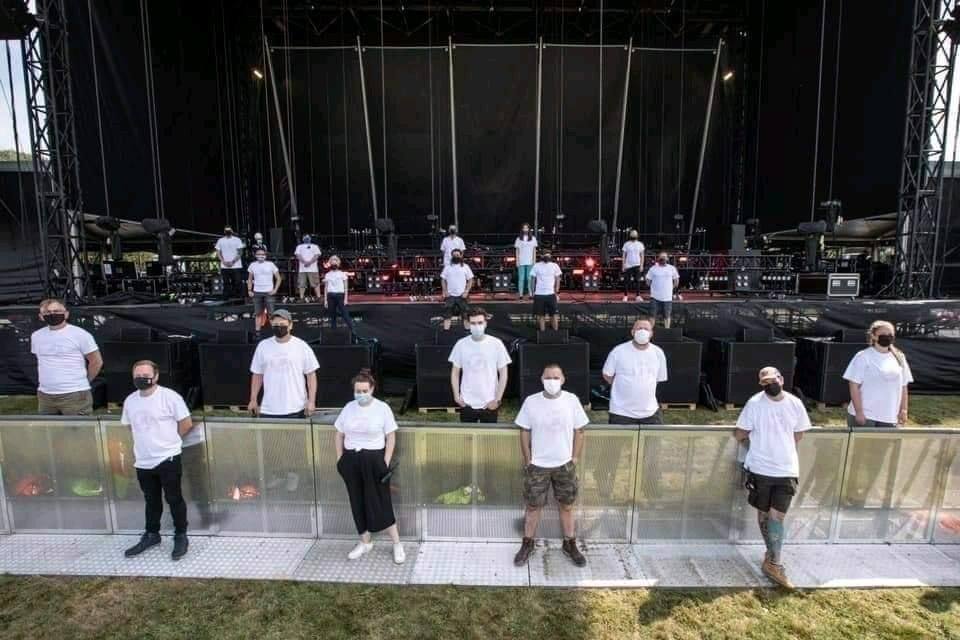
Stand in the pit at a festival and look down at the barrier holding back the front row. Then look at a photo of a town centre defended against a swollen river. You would not think the two had much in common.
The aluminium front of stage barrier that keeps a crowd off a stage and the temporary flood barrier that keeps a river out of someone’s living room are built on the same structural idea.
Both are an L.
Both stay upright for the same reason, and it is not the one you would expect.
We spend our working lives around the crowd version of this kit. So when an ad for a flood barrier turned up in one of our feeds recently, the resemblance jumped out immediately.
It is worth a closer look, because it says something about where good safety engineering comes from and where it ends up.
How a front of stage barrier actually works
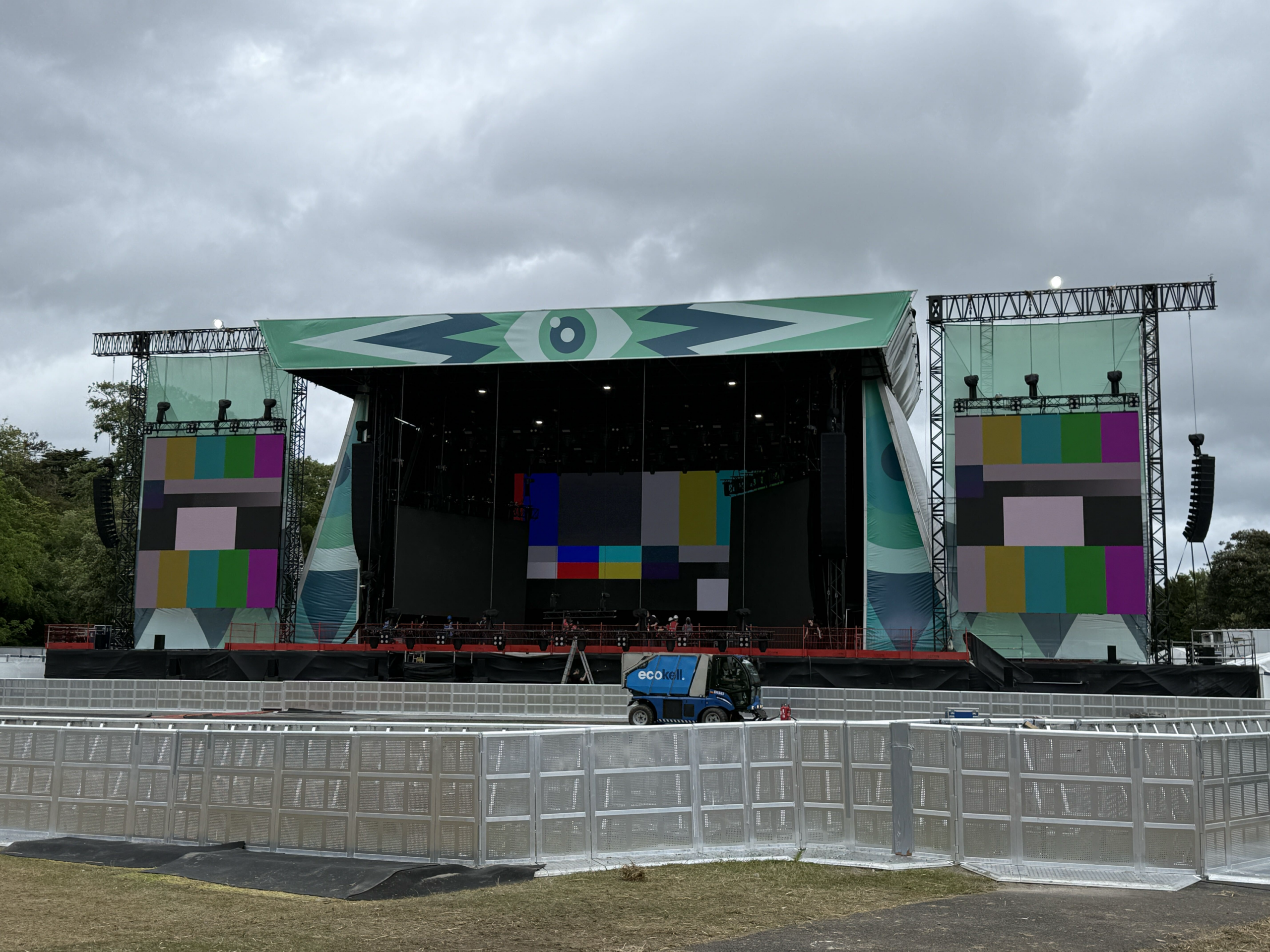
The front of stage barrier, often called a mojo barrier after the Dutch company that popularised the aluminium design, is simpler than it looks.
A vertical panel faces the crowd. A horizontal foot plate sticks out forwards, under where the audience stands. Two braces and a step sit at the back, on the stage side.
The barrier is not bolted to the ground, and it does not need to be.
In Mojo Barriers’ own words, once installed it is “held in place by the audience standing on top of the floorplate on the frontside of the section”.
The crowd’s own weight, pressing down on that forward foot plate, is what stops the whole thing tipping over when the front rows surge into it.
The harder they push, the more bodies pile onto the plate holding the barrier down.
So the crowd pushing against the barrier is also the crowd keeping it upright.
How a self-anchoring flood barrier works
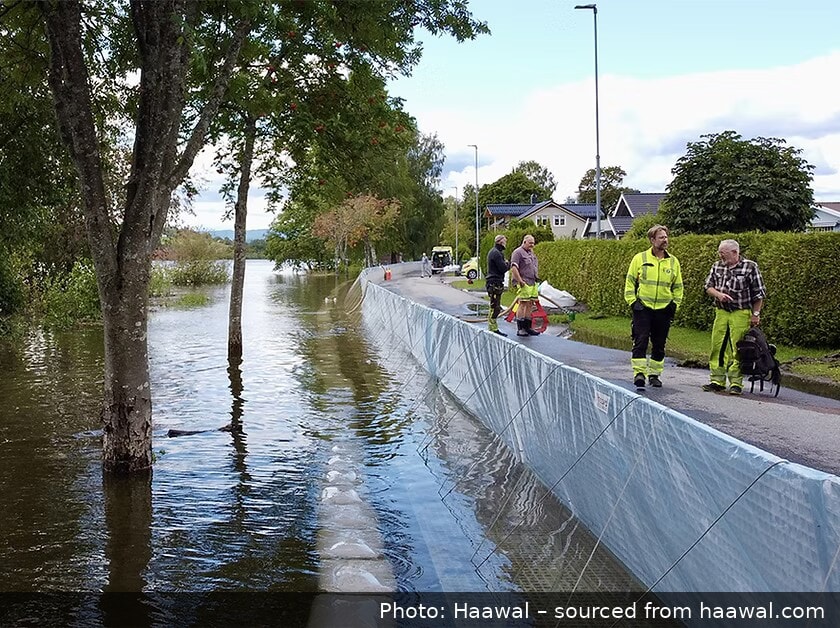
Now look at a temporary flood barrier such as the one made by the Norwegian firm Haawal, which is what an ad in one of our social feeds was selling.
It consists of an upright wall panel and a horizontal base panel, with a membrane that seals against the ground.
An L again.
The ad was about flood protection. What stopped the scroll was the shape, and the explanation of how it stays up, both of which looked oddly familiar.
It is not anchored either. As Haawal puts it, the design “uses the force of the floodwater itself to create exceptional stability, without requiring anchoring or heavy equipment”.
Water rises, presses down on the base panel, and pins the barrier to the ground. The deeper the flood, the harder the water holds the barrier in place.
Engineers call this family of designs self-anchoring, and the logic behind it is sometimes described as the bookend principle.

The shared principle, stated precisely
You could sum both up as “weight on the short leg of the L holds it down”, and that is broadly right.
The neater way to put it is that each barrier takes the load that would topple it and turns that load into ballast. In one case the load is a crowd, in the other it is water, but the move is identical.
There is one honest difference in how the load arrives, and it matters:
- The crowd barrier is loaded intermittently. The foot plate is only doing its job when people are actually standing on it and pushing. An empty pit barrier is a much less stable object than a loaded one.
- The flood barrier is loaded constantly and progressively. Hydrostatic pressure does not take breaks. The water sits on the base panel for the duration, and the load grows automatically as the water gets deeper, exactly when more resistance is needed.
The flood barrier has the easier job of the two. Its ballast is reliable and grows on its own, while a crowd barrier needs an actual crowd to be stable.
At the front of a stage that is a safe assumption, but the dependence is real.
Which came first, and why that is interesting
The question we found ourselves asking was simple. Did the crowd safety world get to this idea before the flood world did?
On the dates, the front of stage barrier has a clear head start. Mojo Barriers grew out of the Dutch live music company Mojo Concerts and has been producing stage barriers since the late 1980s, with the now-ubiquitous aluminium version following soon after and becoming the industry’s most copied design.
Haawal, by contrast, was founded in 2016, and the broader wave of self-anchoring temporary flood barriers is largely a development of the last two to three decades.
A caveat. We have found no evidence that any flood barrier designer looked at a concert barrier and borrowed the idea, so we are not claiming a direct line of inheritance. Self-anchoring and ballast principles crop up independently all over engineering, from highway barriers to coffer dams, and more than one flood product traces its own water-ballast lineage. Good ideas get invented more than once.
What we can say is that the crowd safety world had this principle working at scale long before flood defence did.
Every major festival front of house line you have ever seen is the same idea in action. Even if the flood barrier arrived at it independently, the events industry had already been relying on it, in front of tens of thousands of people a night, for a generation.

Why this is more than a nice coincidence
Crowd safety gets treated as a narrow specialism, something that only matters when there is a stage involved. This barrier story cuts against that.
The thinking that keeps a front row safe, how to resist a load without fixing to the ground, how to build something a small crew can carry and assemble without tools, how to make it sit level on rough terrain, reappears later in flood defence and temporary works.
We see versions of this constantly. A good Risk Assessment technique developed for a music festival ends up useful at a public parade. A flow modelling approach refined on a project like Soundstorm informs how we think about an entirely different site. The disciplines bleed into one another, and that is a healthy thing.
It also says something about what spending on Crowd Safety actually buys. Push an industry to solve hard physical problems for the sake of human safety, and the solutions tend to outlast the problem that prompted them.
The differences worth keeping in mind
For all the structural kinship, nobody should walk away thinking these are interchangeable products. They are solving very different problems and the differences are instructive.
- What they resist. A front of stage barrier resists a horizontal push from people, and is deliberately open so air, sound and sightlines pass through it. A flood barrier has to be watertight, which is why the membrane and the ground seal matter as much as the frame.
- Who loads them. One relies on the protected people themselves to provide stability. The other relies on the thing it is protecting against.
- What failure looks like. A failed pit barrier is a crowd safety emergency measured in seconds. A failed flood barrier is a property and life safety emergency measured in hours. Both are serious, but they fail on very different clocks.
- Access by design. The crowd barrier has a deliberate step at the back so security and medics can reach over the line and extract someone in trouble. That feature exists purely because there are people pressed against the other side. A flood barrier has no such need.
Conclusion
Two barriers in two different industries, landing independently on the same piece of engineering. A panel, a foot plate, and the sense to let the threat do the holding.
We like it as a small reminder that crowd safety work does not stay in its lane.
The engineering and the habits of thought travel, and people end up better protected in places that have nothing to do with a stage.
If you want to talk about the safety thinking behind your event, your site, or your crowd, get in touch. We are happy to compare notes, flood barriers included.
Frequently Asked Questions
What is a front of stage barrier?
A front of stage barrier is the modular metal barrier line installed between an audience and a stage to keep the crowd at a safe distance and give security and medical staff a working space. It is frequently called a mojo barrier, after the company whose aluminium design became the industry standard. Its defining feature is a forward foot plate that the crowd stands on, which holds the barrier in place under load.
Why does a front of stage barrier not need to be bolted down?
Because it is self-stabilising. The horizontal foot plate sits under the crowd, and the weight of the people standing on it counteracts the force of the crowd pushing against the vertical panel. The harder the crowd pushes forward, the more weight is loaded onto the plate holding the barrier down.
How is a flood barrier similar to a concert barrier?
Both are an L-shaped structure that stays upright using load on the horizontal leg rather than ground anchoring. In a concert barrier the load is the crowd’s weight; in a self-anchoring flood barrier it is the floodwater pressing on the base panel. In both, the force that threatens the barrier is the same force that stabilises it.
Did concert barriers exist before self-anchoring flood barriers?
The aluminium front of stage barrier was established from the late 1980s onwards, while the current generation of self-anchoring temporary flood barriers is largely more recent. We have found no evidence of a direct design link between the two, so we would not claim one. The fair statement is that the principle was proven at scale in crowd safety before it became common in flood defence.
Are the two types of barrier interchangeable?
No. A flood barrier has to be watertight and seal to the ground, whereas a front of stage barrier is left open so sightlines and sound carry through, and carries a rear step for medical access. They share a structural principle but are built for completely different jobs.