The Highest-Consequence Work on Any Event Site
Most of what goes wrong on an event site is recoverable. A queue forms in the wrong place, a sign points the wrong way, a delivery turns up late. You fix it and move on.
Work at height is different.
When it goes wrong, people do not walk away. A person falls, or something falls on a person, and you are dealing with a death or a life-changing injury. The safety regulator knows this, which is why it is one of the first things an inspector looks at on an event build. We treat it the same way on every site we run.
This is a companion piece to our wider article on engaging with the HSA on your event site. It works on its own too, as a practical look at the one topic on a build that carries the most risk.
We are not going to recite the regulations here. We want to describe what we expect to see when we walk a site, and the things that tell us a contractor knows what they are doing.
What Counts as Work at Height
The phrase trips people up, so it is worth being plain about it. Work at height is any work where a person could fall far enough to hurt themselves.
There is no height below which it stops mattering. A fall from a metre onto protruding steel or a concrete floor can do as much damage as a fall from a roof.
On an event site, it shows up in a handful of recurring places:
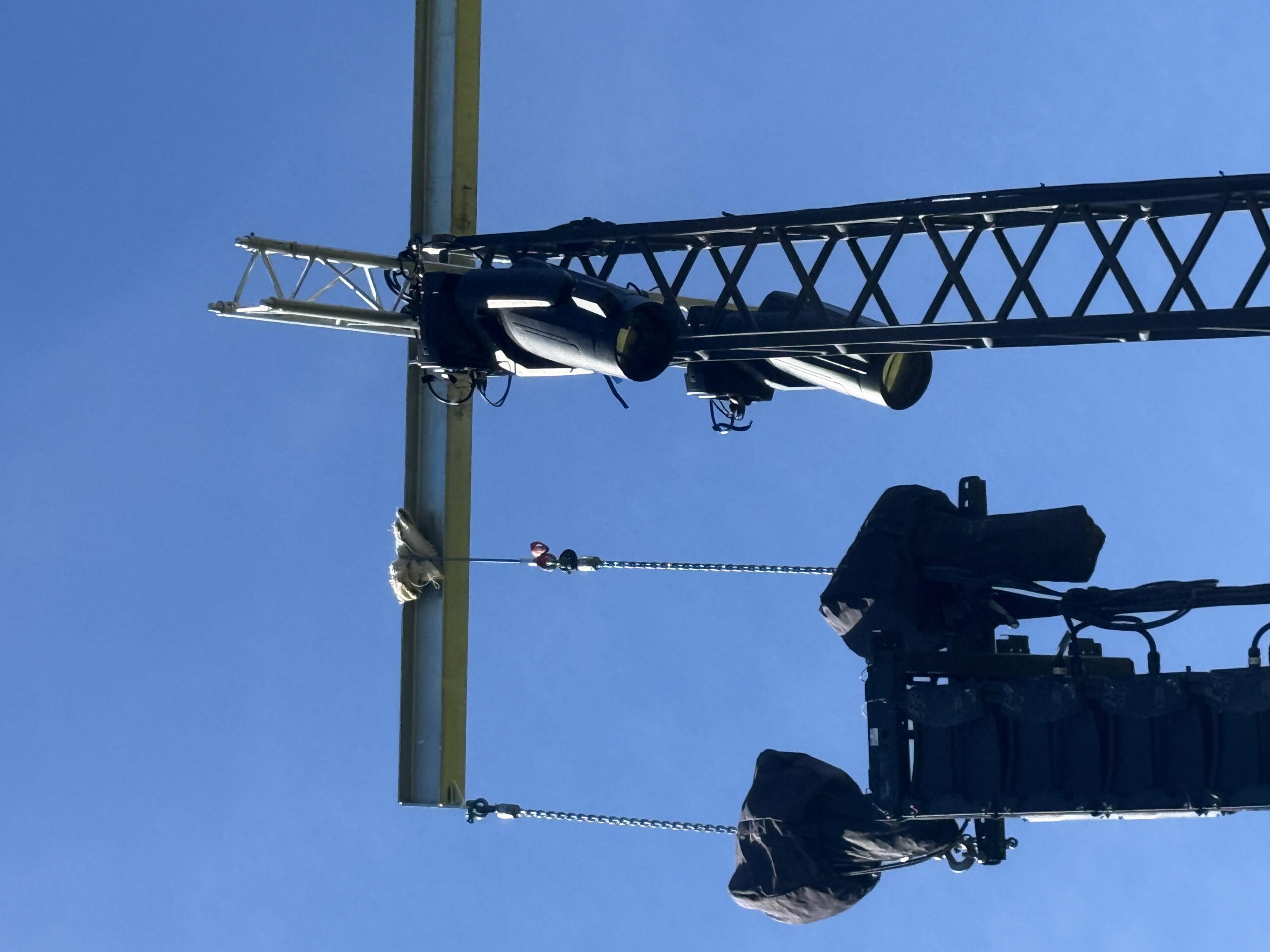
- Rigging: riggers working at high level on trusses, grids and roof structures, often on incomplete or open structures.
- Stage roofs and PA wings: the build and tensioning of roof structures, and the crew working on and around them.
- Towers: delay towers, FOH towers, camera platforms and lighting towers, frequently assembled at pace.
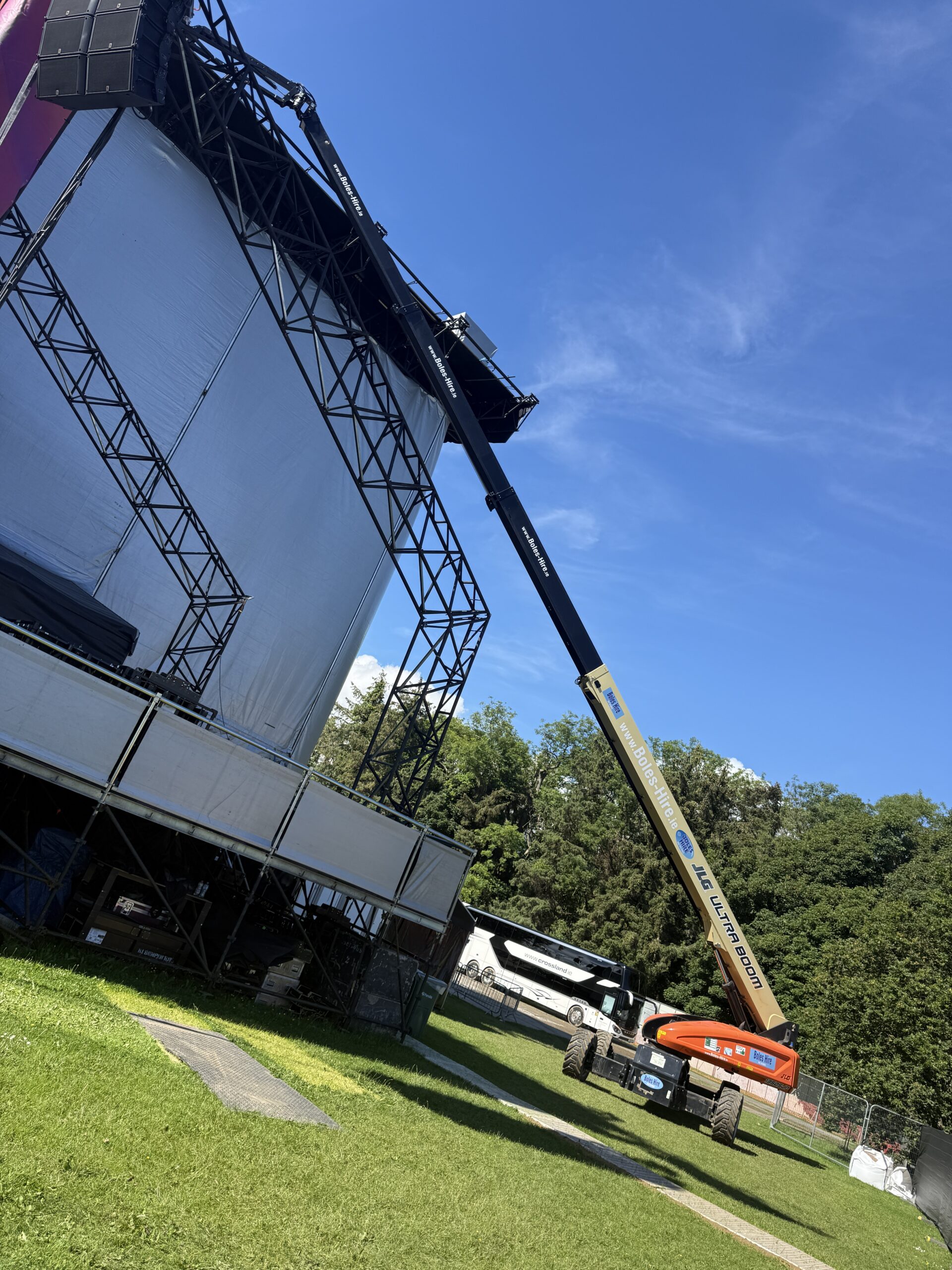
- Access equipment: MEWPs, scaffolds, podium steps and ladders used to reach all of the above.
There are two separate things to worry about with all of these. One is the person up there falling. The other, which gets far less attention than it should, is something dropping onto the people working below.
Fall Prevention Comes Before Fall Protection
There is an order to this work, and good contractors follow it without being asked.
The first question is always whether anyone needs to be up there at all.
Can the structure be built on the ground and lifted into place? Can a fixture be assembled on the deck and flown?
Often it can, and the work at height you design out is the work that can never hurt anyone.
Where someone does have to go up, the priority is to stop a fall before it can happen. A guarded platform, an edge-protected deck, a properly rated MEWP cage. These keep the person away from the edge in the first place, which is why every credible hierarchy puts them above harnesses.
A harness and lanyard only do their job once a person has already fallen. They are a genuine control and we are glad of them, but they sit at the bottom of the order, not the top. If the first thing a crew reaches for is the harness, before anyone has asked whether the trip up is necessary, that tells you how much thought went into planning the job.
The rescue plan nobody asks about
If a fall-arrest system is in use, there has to be a plan to rescue a person who is left hanging in a harness.
Suspension in a harness is dangerous in its own right and can become life-threatening within a short period. A crew that has harnesses but no answer to “how do we get them down” has only done half the job.
We ask the question on every site where fall arrest is in play, and the speed of the answer tells us how seriously the crew has thought it through.
Dropped Objects and the Zone Below
A spanner dropped from a truss does not need to fall far to kill someone. This is the risk the crew up top thinks about least, and the one the people underneath can do nothing about.
Good practice on the ground looks like this.
An exclusion zone sits under any live overhead work, drawn wide rather than tight, and physically closed off with barrier so nobody wanders into it. Tools used at height are tethered. Anything not needed for the job comes out of pockets and off the platform before the work starts. The zone stays up until the overhead work is finished and someone has actually checked it.
This is the thing we look at first on a build, because it is the easiest to read. A properly sized, barriered exclusion zone that everyone respects, including the crew who find it a nuisance, means the site is being run by people who get it.
An exclusion zone with production traffic cutting straight through it is just tape on the ground.
We worked on a festival one time, where the main stage production build was behind schedule. Multiple contractors were working simultaneously, some at height and some on the stage level. During sound checks small items were falling from above onto those working on stage. Activities were paused and contractors went up high to brush off the items from the lighting fixtures etc. This was a very high stage too so the risk was significant from items falling.
Weather Turns a Safe Structure Into an Unsafe One
A stage roof or tower that is perfectly safe in still air is a different animal in wind.
Temporary structures are engineered to operating limits, and those limits include wind. There is a speed at which work has to stop, and a higher speed at which the structure itself has to be cleared or taken down.
What good looks like here is easy to state and missing more often than you would expect.
Someone owns the weather.
A named person is watching the forecast and the live wind readings against trigger points that were agreed in advance, and that person can stop work and clear structures on their own authority. The trigger points are written down before the build. They are not something to start debating on the day, with the anemometer already climbing and a show due to open.
This connects directly to how we think about Safety by Design for events. A wind plan is a decision you make in the quiet of the planning phase, while you still have the time to make it properly.
Who Is Competent, and How You Know
Work at height has to be done by people competent to do it, and competence is not something a contractor gets to claim for themselves and leave at that.
Riggers, MEWP operators and scaffolders all hold recognised qualifications and cards for their trade. Asking to see them is a fair question and a competent contractor hands them over without bristling.
Competence also shows up in paperwork that should exist before anyone leaves the ground.
A Method Statement that sets out how this particular lift or build will be done. A Risk Assessment that has actually engaged with this site and this task, not a template with the venue name swapped in.
When that paperwork is thin or vague or obviously recycled, it usually tells you what the work itself is going to look like.
What We Look For When We Walk the Site
So when we walk a site, here is the short version of what tells us work at height is in good hands:
- Someone has visibly asked whether anyone needs to be up there at all.
- Falls are being prevented at the edge, before harnesses come into it.
- There is a rescue plan for anyone on fall arrest.
- Exclusion zones under overhead work are wide, barriered and respected.
- Someone owns the weather, with written trigger points and the power to stop work.
- Competence can be shown on request, in cards and in task-specific paperwork.
None of this is exotic.
It is ordinary, careful practice, and the gap between a crew that does it as a matter of course and one that has cut the corner often enough to stop seeing it is the gap that hurts people.
Working at height done wrong, Safety Advisoring done right
On a busy concert site this Summer I saw a very experienced event professional work at height in a manner he shouldn’t. While it wasn’t the worst way I’d ever seen, it wasn’t the best by a long shot.
I was the opposite side of the arena when I spotted him and when I got closer he had already come down.
The other Safety Advisor – who had worked there far more days than I had and had developed relationships with key people on site – was due on site within the hour. I decided to wait and discuss it with him when he arrived.
As is typical, things came up, we got distracted by other issues and I’d not gotten to speak to (let’s call him) Tim when the guy who’d been up high found us.
He came straight to Tim and said ‘I’ve an admission to make’ and he proceeded to explain what he’d done, why he’d done it etc. They had a great discussion as to how he could have done it in a safer way, what the options were, why he hadn’t done it any of those ways etc.
I thought it a great illustration of the relationship Tim had with key contractors on site. Despite thinking he had gotten away with what he did, he actively wanted to let Jim know and own up to it.
THAT, to me, is the type of relationship Safety Advisors should have with people working on site.
And that’s not a Safe Events Global humblebrag or anything. Tim doesn’t work with us. We were just working alongside him on a particular concert.
The Companion Reference Worth Reading
For the full treatment of the duties around working at height, the body-of-reference document is the safety regulator’s own guidance. The Irish version, Guide to the Safety, Health and Welfare at Work (General Application) Regulations 2007, Part 4: Work at Height, sets out the legal duties in detail and applies the same principles we describe here.
It is written for duty-holders rather than for a general audience, so it reads as a regulatory document, but it is the authoritative source behind the practical points above.
If you want the events-specific layer on top of the general duties, the industry guidance on rigging and temporary structures from specialist bodies covers the production context in more depth.
Where We Fit
On a lot of the events we work on, we hold the build and break safety responsibility ourselves. That puts work at height squarely on us to oversee. It is true as true on long-term builds as well as on concert and festival events.
If you are planning an event with significant work at height and you want it overseen by people who treat it as the highest-consequence work on the site, our Event Safety service is built around exactly that. Get in touch and we will talk it through.
Frequently Asked Questions
What is classed as work at height on an event site?
It is any work where someone could fall far enough to hurt themselves, and there is no height below which it stops counting. On event sites it usually means rigging, stage roofs, towers and the access equipment used to reach them. A fall of a metre onto steel or concrete still counts, and can still be serious.
Is fall arrest enough on its own?
No. A harness only catches a person once they have already fallen, so it is the last line of defence, not the first. Good practice designs the work at height out where it can, then stops falls at the edge with guarding, and leans on fall arrest only where nothing else will work. Any fall-arrest system also needs a rescue plan for getting a suspended person down quickly.
Why does an exclusion zone matter so much?
Because a dropped tool or component can seriously injure or kill a person below, and the people below have no way to protect themselves from it. A generously sized, physically closed exclusion zone under live overhead work is the clearest single sign that a build is being run by people who understand the risk.
When should work at height stop because of wind?
Temporary structures have engineered operating limits that include wind. Work should stop at pre-agreed wind speeds, and structures may need to be cleared or reconfigured beyond that. What matters is that a named person is monitoring the weather against written trigger points and has the authority to stop work before conditions become dangerous.
How do I check a contractor is competent for work at height?
Ask to see the relevant cards and qualifications for riggers, MEWP operators and scaffolders, and ask for a method statement and Risk Assessment specific to the actual task and site. A competent contractor provides these without hesitation. Generic, recycled or vague paperwork is usually a fair signal of how the work itself will be carried out.