Introduction
We hand people the keys to a buggy on an event site like it’s nothing. A quick point at the pedals, a wave towards the vehicle compound, and off they go.
We rarely give buggy safety on event sites the attention it deserves, and people get hurt as a result.
We put this question to our network recently over on LinkdIn and the response was telling.
Story after story came back, some funny, plenty frightening. Broken legs, a smashed femur, staff in hospital, buggies flipping on corners because someone decided the site did not need speed limiters.Almost everyone had a tale, and few thought their own event handled buggies as well as it should.
So, what should we actually be doing? Here is where we landed, drawing on what people shared.
Why a Buggy Is Not Treated as a Serious Risk
A buggy looks harmless.
It is small, it is slow by the standards of a van, and it carries the associations of a leisurely round of golf. That is the mindset that ends up hurting someone.
Laurel Knight, who runs an event medical cover company and has attended serious buggy incidents over the years, put it plainly – they can cause life-changing injuries despite often being seen as “just a buggy”.
Her point went further. It is easy to fixate on who can drive one, she noted, but people also need to understand the environment, with pedestrians, changing ground and other vehicles sharing the same space. A short site-specific familiarisation, in her words, can make a real difference.
Sarah Tudno-Jones, who specialises in accessibility in live event operations, was blunter still. A buggy, she said, is “a piece of site plant and should be treated as such”. We agree completely.
The vehicle itself does little to help.
Many have no speedometer, and the accelerator behaves like a go or stop switch rather than a variable control. Don Wetherell, who has worked events for years, made the point that a buggy tends to go flat or stop, and that the brakes in his transit van are far better than a buggy’s. On a busy build, that machine shares ground with contractors, forklifts, cabling, changing surfaces and members of the public.
Get buggy safety on event sites wrong and you are risking a serious injury, a licence, and an insurance position that collapses the moment something goes wrong.

The Licence Question, and Why It Misses the Point
The debate almost always lands on one question first.
Do you need a driving licence to drive a buggy?
It is the wrong place to start, though it matters.
A full driving licence is a reasonable baseline for most event use, and often the simplest control to apply. Steve Ross works in construction health and safety and argued that a driving licence and a safety briefing should simply be standard, and that this is not going to any great lengths.
The insurance argument sits right alongside it. Jacob Butler, who has run car parks at large events, warned that most policies assume the driver holds the correct licence, so it is fine to drive a buggy right up until the moment they crash, and then it is not.
But a licence on its own proves you can drive a car on a road. It does not prove you understand a buggy, or the site you are driving it on.
Michael Evans, a freelance operations manager who drives a 6.5 tonne ice resurfacer all winter, has driven buggies on sites for over ten years without a road licence. His view was that a driving licence, or good experience and another plant licence with a solid safety brief, is the way to go. Reasonable people can make that case.
Our own position is that a driving licence is the right default in most cases, with an allowance for recognised plant qualifications where it makes sense.
Whatever entitlement you accept, the licence is the entry ticket, not the whole show. Rob McCutcheon, who provides ATV and UTV training, made the legal point squarely: regardless of a driving licence, under the PUWER regulations an operator of any equipment must receive sufficient and adequate training to operate it safely. The equipment includes the buggy.
The duty sits with the employer or the organiser, and it does not disappear because the vehicle looks friendly.
What Standard Practice Should Actually Look Like
Pull the good practice out of the noise and a clear standard emerges.
None of it is exotic. It is the same disciplined approach we would apply to any other piece of moving plant on site, and it starts, as everything should, with a Risk Assessment for buggy use specifically.
At a minimum, we would expect to see:
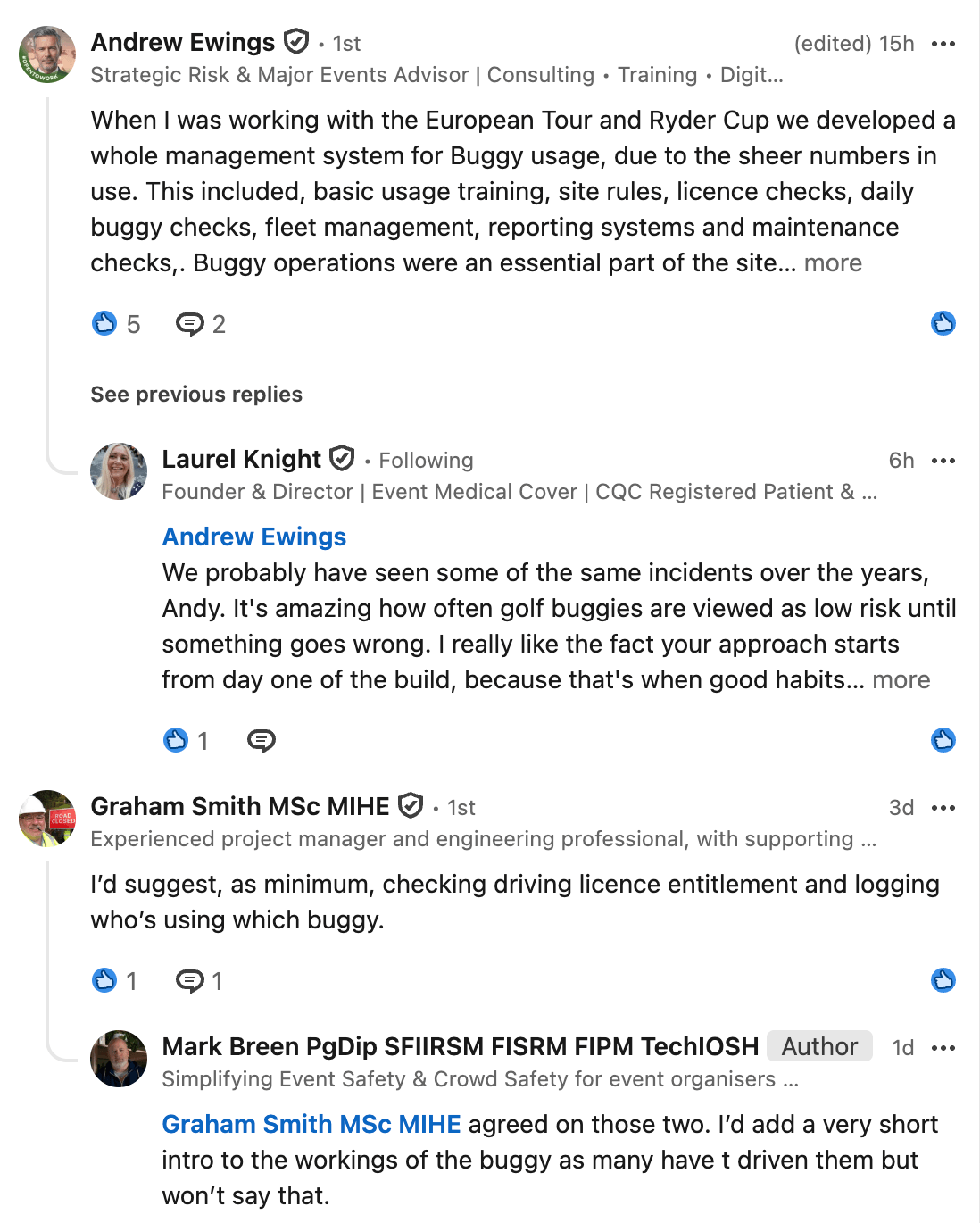
- Entitlement checked and logged: confirm the driver holds the entitlement you have decided on, and record who is cleared to drive which vehicle. Logging who is using which buggy is not bureaucracy, it is how you keep control of the fleet.
- A site induction and driver brief: cover the routes, any vehicle exclusion zones, curfew or quiet times, speed limits, and the specific conditions on your site. A short, site-specific familiarisation makes a real difference.
- A quick introduction to the vehicle: many people have driven a buggy but will not admit they have not, and the go or stop accelerator catches them out. A two-minute run through the controls closes that gap.
- Speed limiters engaged: if the buggy has a restrictor, use it. Turning it off to shave a few seconds is how buggies end up on their roof on a corner.
- Daily checks and basic fleet management: brakes, tyres, lights and general condition, checked and recorded, with a clear owner for the fleet.
- Key control: keys secured when vehicles are not in use. This is the hardest one to hold, and we come back to it below.
At the larger end, this becomes a full management system.
Andrew Ewings, who worked with the European Tour and Ryder Cup, described building a whole management system for buggy use because of the sheer numbers involved: usage training, site rules, licence checks, daily buggy checks, fleet management, reporting and maintenance, with buggy operations treated as core site safety from day one of the build.
Howard Letch, who works in Olympic and Paralympic delivery, noted that at Yas Marina Circuit you take a buggy driving course before they hand you the keys, and rated that as the right way to go.
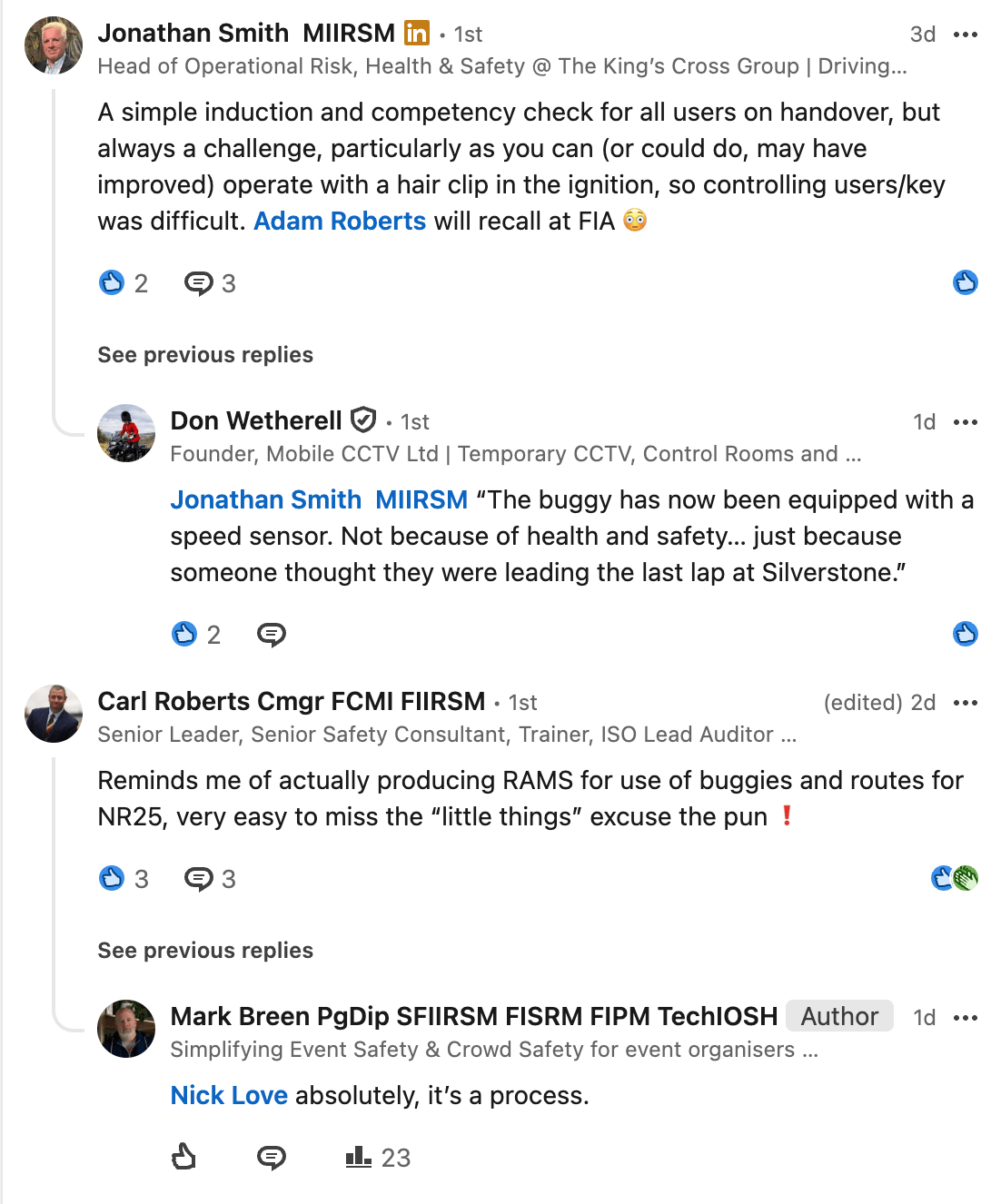
Carl Roberts made the point that this is exactly the kind of thing that gets missed: he recalled producing RAMS for buggy use and routes on a major project, and how easy it is to overlook the “little things”. You do not often see a Risk Assessment and Method Statement written for buggy use, and that is precisely the gap.
Where It Slips on Live Sites
Writing the standard down is one thing. Holding it on a busy site is where it tends to fall apart, and the stories we gathered show where.
Key control is the perennial weak point
Buggies are notoriously easy to start.
Jonathan Smith, head of operational risk at a major venue, described being able to operate one with a hair clip in the ignition, which made controlling users and keys genuinely difficult. Others talked about using almost anything to turn the lock. Jacob Butler once found a buggy in his car park and had no idea how it had crossed the road to get there. When anyone can start the vehicle, a carefully written driver policy stops meaning very much.
The rules get quietly undermined
Jacob also flagged a familiar pattern. An info sheet on the buggy states that a licence is required, then on-site security keep a few spare vehicles aside because they know some managers do not hold one. Graham Kavanagh described buggies used by intoxicated staff, indiscriminate use, vehicles left unsecured, and vendors with no accountability for how theirs are used. The written rule and the lived reality drift apart, and the gap is invisible until an incident exposes it.
The “Mario Kart” problem
Some of what people described was closer to a racing game than a work environment. Nick Love, who advises on safety in the entertainment industries, recalled racing buggies around the Millennium Dome at the end of a night shift, chased by security, and separately a colleague who smashed his femur to bits driving with his foot dangling outside the vehicle.
Adam Roberts, a health and safety advisor, said the worst injury he has had on a long build was down to a buggy roll. Add in the intoxicated driving and the limiters hot-wired out because someone fancied themselves as leading the last lap. It is funny until it is a femur.
Speed is genuinely hard to manage
Even with the best intentions, these are not easy vehicles to moderate. Sites set limits of five or ten miles per hour, but a buggy tends to go flat or stop, and the brakes are weaker than anything the driver is used to. Gregor Murray described a large-scale event where a new lead decided the speed restrictors did not need to be activated. The result was several buggies overturning on corners, a broken leg, a broken arm and several staff in hospital. That is exactly why the engineering control, the limiter, matters so much, and why turning it off is such a poor decision.
A Lesson Worth Holding On To
Don Wetherell summed the whole topic up in a single line. They fitted a speed sensor to one of his buggies, he said, and “not because of health and safety”. Someone had been treating the last lap like Silverstone.
Lesson learned: the control went in after the behaviour, not before it. That is the pattern we want organisers to break. The buggy that looks harmless in the compound is the same machine that puts a member of staff in hospital when you hand it to the wrong person, on the wrong ground, with the limiter off. Build the controls in from the start. That is what Safety by Design actually means, rather than adding them after the near miss.
Conclusion
None of this is complicated, which is what makes it frustrating. The measures are cheap, quick and well understood: check and log entitlement, brief the driver on your site, keep the limiter on, mind the keys, and check the fleet. Assess the risk properly and treat the buggy as the piece of plant it is.
We plan for vehicle movement as a matter of course, because a buggy is just another moving hazard to manage alongside the rest.
If you want that discipline running on your event, this is exactly what our Event Safety service is for. Get in touch and we will talk it through.
Frequently Asked Questions
Do you need a driving licence to drive a buggy on an event site?
There is no single legal answer. It depends on where you are driving the buggy and what your insurer requires. A full driving licence is a sensible default and often the simplest control, but relevant plant qualifications paired with a proper safety brief can also be appropriate. The important point is that the entitlement you accept should be a deliberate, risk-assessed decision, not an accident.
What is the biggest risk with buggy safety on event sites?
Underestimating the vehicle. A buggy is a piece of moving plant sharing space with pedestrians, contractors and changing ground conditions, yet we routinely treat it as harmless. That perception gap, combined with weak key control, is where most serious incidents begin.
Is a driving licence enough on its own?
No. A licence shows a person can drive a car on a road. It says nothing about whether they understand the buggy or the site. Under equipment safety law, operators of work equipment still need adequate training regardless of any road licence they hold, so a site induction and vehicle familiarisation are essential on top of the entitlement check.
Why does key control matter so much?
Because buggies are very easy to start, sometimes with little more than a hair clip. If anyone on site can take a vehicle, your driver policy is unenforceable. Securing keys when buggies are not in use is one of the simplest and most overlooked controls there is.
Should you always use speed limiters?
If the buggy has one, yes. Buggies are hard to moderate, the accelerator often behaves like an on or off switch, and the brakes are modest. The limiter is the engineering control that keeps a moment of poor judgement from becoming a rollover, so disabling it to save a little time is a poor trade.