Introduction
Most of the crowd safety story at this World Cup is playing out away from the stadiums.
The stadium itself is the manageable part. You have a known capacity, controlled entry, and a venue operator whose job it is to run it. The harder part is happening in the streets, on the train platforms, and along the walking routes between the transport hubs and the grounds.
That space has a name. In sports-ground guidance it is called Zone Ex, the external zone. Most people know it as the last mile.
It is the stretch nobody quite owns and everybody has to plan for, and this tournament is stress-testing it in public, city by city. We have been watching how the host cities handle it, and the contrast between them tells you a lot if you plan events for a living.
If you want the definitional grounding on Zone Ex, the Sports Grounds Safety Authority sets it out, and Íse Murphy-Morris, who wrote the dedicated chapter for the Purple Guide in 2024, explains it well.
This piece assumes that and goes to the live question: what does the last mile look like when 80,000 people actually turn up?
Why the Last Mile Is the Hard Part
The reason the last mile is difficult is structural.
The routes that make it up are mostly public roads, station concourses and open squares, and they almost always fall outside the legal control of the venue or the event organiser. You do not own them and you cannot fence them. They still fill with your crowd, because of your event. Responsibility ends up split across the city, the transport operator and the police, and split responsibility has a habit of turning into nobody’s responsibility on the night it counts.
A Risk Assessment that stops at the perimeter fence has a blind spot precisely where a lot of the risk lives. What makes this World Cup worth watching is which cities understood that and planned for it, and what happened where the plan met reality.
The Cities That Planned the Journey
Some host cities have treated the last mile as a design problem rather than an afterthought, and it shows.
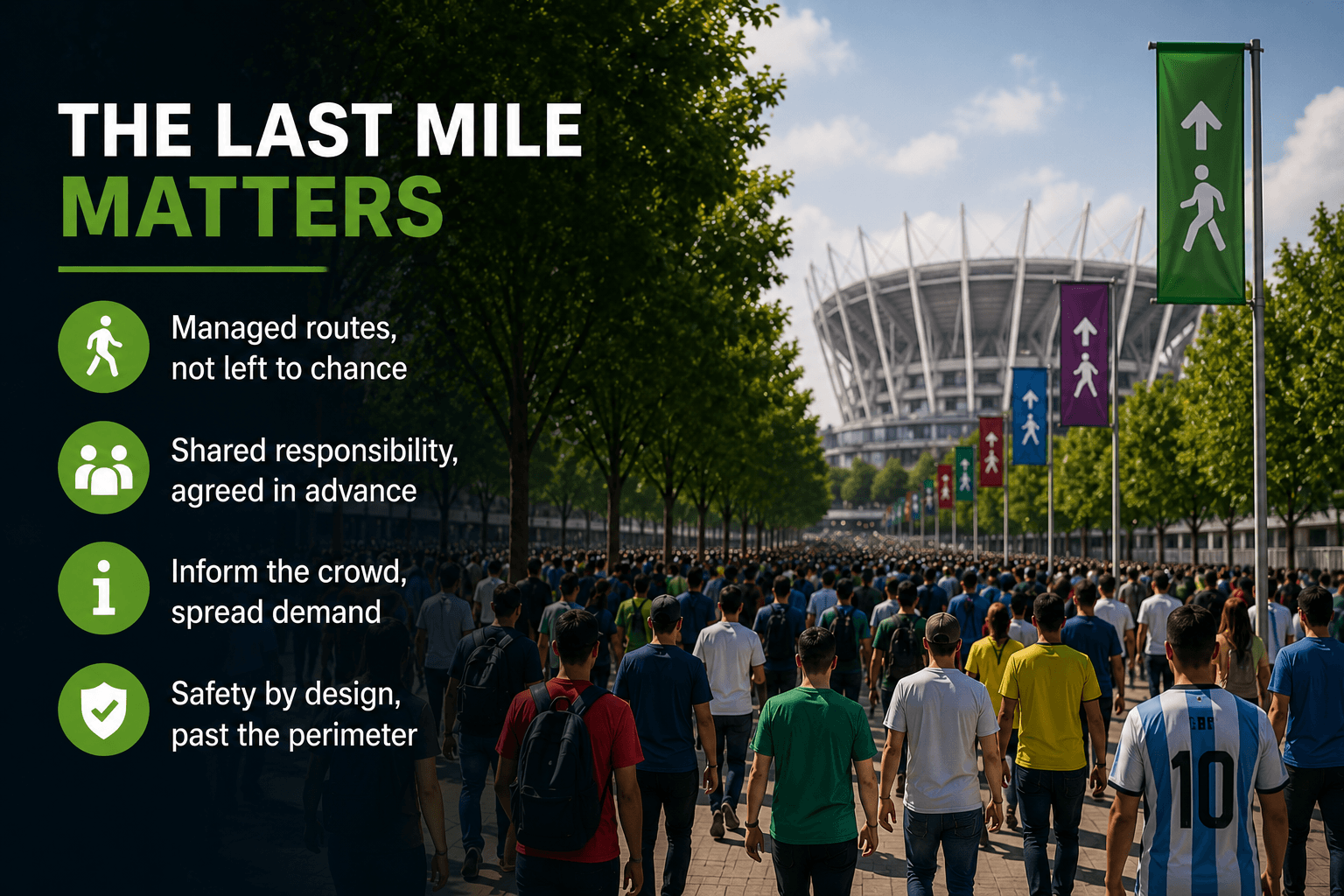
Vancouver set up a controlled area roughly two kilometres across around its stadium on match days, with a dedicated pedestrian route guiding fans between the SkyTrain stations and the ground before and after each game.
Toronto did much the same, with its own two-kilometre controlled zone. These are last-mile plans in everything but name: a managed route, agreed in advance across the city, the transit operator and the police, with the walking journey designed rather than left to chance.
New York and New Jersey went furthest.
Access to the stadium has been limited almost entirely to official transport, with rail services funnelled through a single interchange at Secaucus Junction, where ticket holders transfer to matchday-only trains and buses for the final leg.
It is a heavily engineered last mile that trades spontaneity for control, and for a venue of that scale, with the final on the line, you can see the logic.
Then there is Boston, which took the most honest approach of the lot.
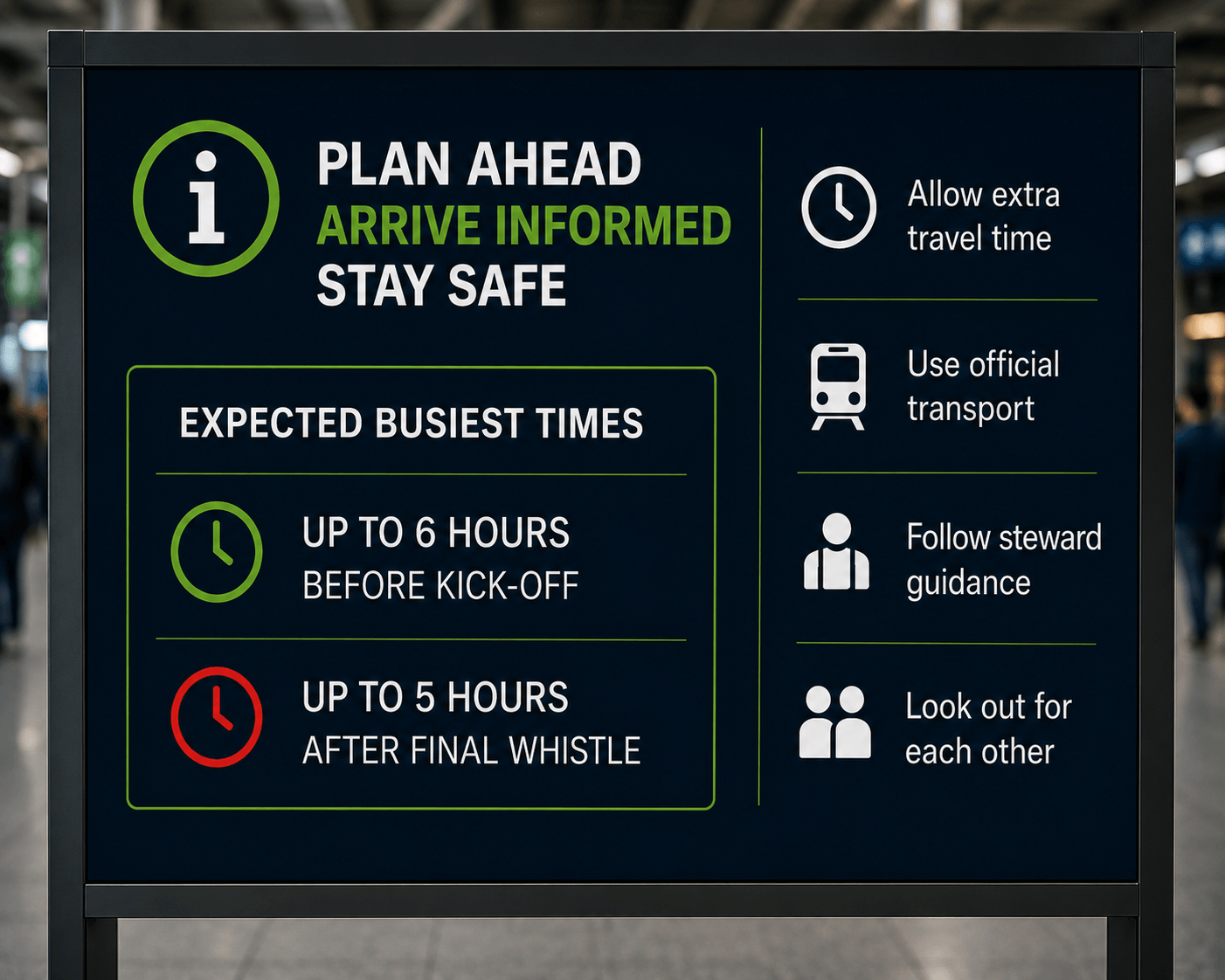
Boston has told the public plainly that crowding is expected at its main downtown station for up to six hours before kick-off, and for up to five hours after the final whistle, with organised fan walks adding to the pressure. The point is to get the crowd arriving informed and spread out rather than all at once.
Honesty about timing does a lot of the crowd management work for you, before anyone has left the house.
The Cautionary Case
The other side of the lesson came on the opening day, in Mexico City.
The fan zone reached capacity and supporters were turned away and redirected to other plazas, while road closures left people walking an hour or more to reach the area around the stadium.
The venue was managed. The official fan sites were managed. The overflow went where it always goes, into the public space between everything, on foot, in the heat, with a long way still to walk.
Nobody was hurt, and this is not a story about Mexico City getting it wrong.
It is a story about what the last mile does. It absorbs whatever the stadium and the fan zones cannot hold.
If you have planned for it, you can shape where that overflow goes. If you have not, it still happens, just without you in the room.
What an Organiser Should Take From This
You do not need an 80,000-seat stadium for any of this to apply.
The moment your event is big enough to move a crowd through public space, you have a last mile, and the same questions land on your desk. Watching the World Cup handle it at scale makes the principles easy to see.
It is Safety by Design reaching past the fence line.
Three things stand out from how the better cities are doing it.
- The first is to map the journey, not just the venue. Walk the routes your crowd will use, from each transport hub to your gates and back. The pinch points, the narrow bridge, the single station exit, the junction where people and traffic cross, are usually obvious the moment you walk it.
- The second is to get the agreement in place before the day. Because no single party owns the last mile, the plan only holds if the local authority, the police and the transport operators have all signed up to who does what. The most useful thing you can bring to that conversation is a clear, written map of responsibility, settled in advance rather than argued over at eleven at night.
- The third is to manage demand with information. Boston’s six-hour warning is the model. Tell people when it will be busy and where, and a good portion of them will adjust before they leave home. Signage, stewards and live alerts then nudge the rest toward the routes you want used.
None of this needs you to own the land. It needs you to treat the journey as part of the event and pull the right people together early.
The Point
The last mile is where this World Cup’s crowd safety is genuinely being decided, in the gap between the station and the gate that no single organisation controls.
The cities reading it well are the ones that planned the journey, agreed the responsibility, and told the crowd the truth about what to expect.
Your duty of care does not end at the perimeter fence, and the tournament is making that point in real time.
If you are planning an event and want help thinking through the journey as well as the venue, our Crowd Safety team is glad to talk it through. Get in touch.
Frequently Asked Questions
What does the last mile mean for World Cup crowd safety?
The last mile is the public space outside the stadium that fans move through arriving and leaving: the station concourses, the walking routes, the squares and the car parks. A large share of World Cup crowd safety risk sits in that space rather than inside the venue, because it is densely packed, lasts for hours, and falls outside any single organisation’s direct control.
What is Zone Ex?
Zone Ex, meaning the external zone, is the formal term for the last mile in sports-ground guidance. It was coined by the Sports Grounds Safety Authority and appears in the Green Guide, and the Purple Guide added a dedicated Zone Ex chapter in 2024. The last mile is the more widely understood plain-English name for the same area.
How are World Cup host cities managing the last mile?
Approaches vary widely. Vancouver and Toronto built controlled areas of roughly two kilometres around their stadiums with managed pedestrian routes. New York and New Jersey restricted access almost entirely to official, ticketed transport. Boston chose radical transparency, warning of multi-hour station crowding so fans plan around it. Each is a different answer to the same problem.
Who is responsible for crowd safety outside the stadium?
Responsibility is shared, which is what makes it hard. The routes usually belong to local authorities, transport operators or other landowners rather than the venue or organiser. Even so, the organiser is expected to coordinate and agree safety arrangements across all those parties before the event, rather than treating the space as somebody else’s problem.
Does the last mile only matter for huge events like the World Cup?
No. Any event large enough to move a crowd through public space has a last mile, including concerts, festivals, fan zones and parades. The World Cup simply shows the challenge at its largest scale. The blurred responsibility for the routes in and out is the same whatever the size.