Why Continuous Hazard Lights on Event Sites Create More Risk Than They Prevent
Spend any time on a busy event site and you will see a wide range of vehicle behaviour.
We certainly have in recent months, whether working on events in the Middle East or closer to home.
Site buggies weaving between stacks of truss. Vans reversing into tight compounds. Telehandlers carrying loads across uneven ground. Movement everywhere, often in confined and constantly changing spaces.
One behaviour, however, keeps cropping up time and again. Drivers switching on their hazard lights and leaving them on while driving around site.
The intention is sound. Most people believe that flashing lights make them easier to see and, therefore, safer.
In reality, the opposite is true. Driving with hazard lights on does not reduce risk on an event site. It increases the risk.
Visibility and clarity are not the same thing. Event sites rely far more on clarity.
We need to look at how people read vehicle movement, how hazard lights interfere with communication, and why the UK’s Haz Off campaign is such a useful reference point.
Why Hazard Lights Seem Like a Good Idea, but Are Not
Event sites are visually busy environments.
Lighting rigs, high-visibility clothing, reversing beacons, plant and temporary infrastructure all compete for attention.
In that setting, it is easy to assume that more lights equal more safety. A pair of flashing amber lights feels like a sensible precaution.
The problem is that hazard lights only communicate one thing: a stationary vehicle that is acting as an obstruction. They were never designed to be used on a moving vehicle.
When hazard lights are left on while driving, they completely mask the most important communication tool a driver has: the indicator. Once that signal is gone, everyone else on site is left guessing.
On a live event site, guesswork gets people hurt.
Decisions are made in split seconds, and predictability is a core part of keeping people safe.
How Hazard Lights Create Confusion
Much of the risk here comes down to simple misunderstanding.
When a vehicle is moving with hazard lights flashing, nobody else can clearly tell what the driver intends to do next. The usual visual cues are gone.
On sites with multiple contractors, unfamiliar drivers and changing layouts, that confusion is amplified.
A van turning becomes indistinguishable from one travelling straight ahead. A driver slowing for a junction looks no different from one stopping to reverse.
That’s where hesitation creeps in, and hesitation on a busy site leads to near misses.
Pedestrians may step out expecting a vehicle to continue straight. Other drivers may pull out, assuming a vehicle ahead is stopping. Banksmen lose one of their most important visual references.
Everyone is forced to assume, rather than observe.
This is logical stuff, right?! How we drive on event sites should largely mirror how we drive in the real world. Broadly speaking, assuming good driving behaviour.
I was recently driving my daughter to play school and passing through a residential area near where I live. The van in front of us turned on its hazard lights and, surprisingly to me, swung across the road to the right to reverse into a property on the left.
That’s hazard lights in a nutshell. The driver thought he was being safe. I nearly drove into him.
The fact he turned on his hazards and slowed down made me think he was pulling in to the left or stopping on the road. So I expected to be able to go around him.
I couldn’t, given that he swung across the road to the right.
This type of thing happens on ‘real roads’ and it happens on event sites too.
Why Visual Noise Makes Sites More Dangerous
It is a common assumption that more lights automatically mean more safety.
Event sites challenge that idea.
With so many visual stimuli competing for attention, additional flashing lights simply add noise. What really matters is not how bright a vehicle is, but how clearly it communicates its intentions.
A vehicle with its hazard lights flashing will almost certainly be noticed.
What it will not be is understood.
On an event site, intention is everything. When that intention is unclear, risk increases.
Temporary junctions become harder to manage, crossings become less predictable and coordination between vehicles and pedestrians starts to break down.
The Haz Off Campaign and What It Teaches Us
In the UK, the Haz Off campaign was launched specifically to address the widespread misunderstanding around hazard light use.
The campaign highlights how hazard lights reduce the clarity of normal signalling, create complacency and contribute to unnecessary near misses.
Its advice is deliberately simple: drive exactly as you would on a public road.
Use indicators to show your intention. Use hazard lights only when your vehicle is stationary and causing an obstruction.
It is a clear, practical message, and one that translates perfectly to live event environments, where clarity of movement is even more important due to the mix of pedestrians, plant and vehicles operating in tight spaces.
Event Sites Are Workplaces, Not Free-for-All Zones
There is a persistent misconception that event sites are somehow exempt from normal driving expectations.
In reality, they are workplaces.
Vehicle movement is one of the highest-risk activities within them.
Good practice depends on disciplined, predictable behaviour. That means driving slowly, signalling clearly, maintaining space, following marshals and banksmen, yielding to pedestrians and avoiding unnecessary distractions.
Hazard lights undermine this by removing one of the most basic elements of road communication: the indicator.
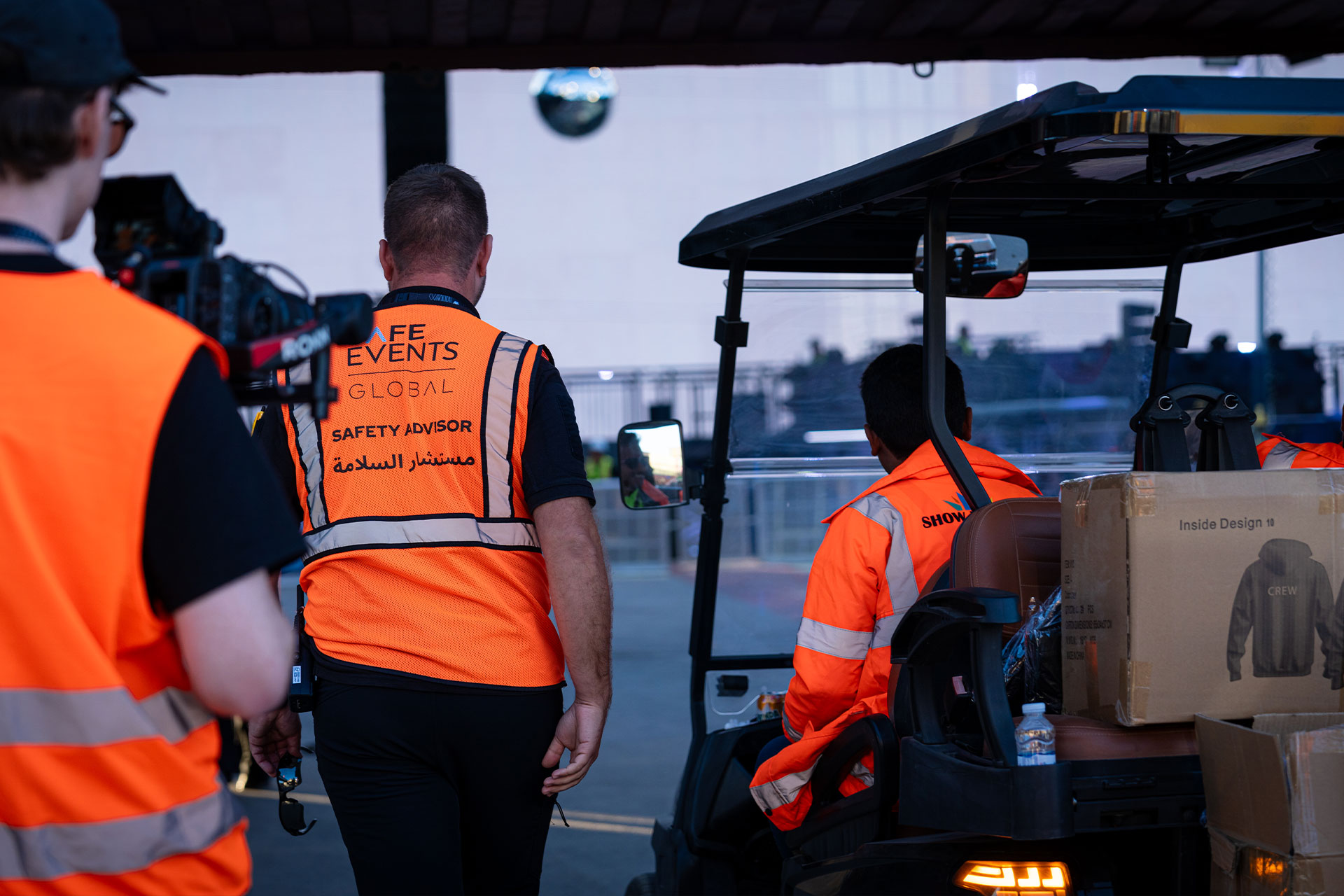
We recently worked on an event that, at one point, had 22 cranes operating in the same area of site, alongside standard vehicle traffic.
In environments like this, you need every bit of clarity you can get.
Real Risks Caused by Hazard-Light Driving
This goes beyond just avoiding collisions. It’s about the whole site moving predictably.
Across the industry, continuous hazard-light driving has contributed to a pattern of recurring issues. These are rarely dramatic incidents. Instead, they are small misunderstandings that create ripple effects if left unchallenged.
Pedestrians misjudge a vehicle’s direction.
Drivers are caught out by unexpected turns.
Temporary junctions become harder to control.
Banksmen find themselves trying to manage movement without the support of clear indicators.
A single hesitation at a crossing can cause a bottleneck.
A poorly judged turn can force workers into unsafe areas.
A vehicle nobody can read creates problems in a space that’s already demanding everyone’s full attention.
Encouraging Better Practice
Changing this behaviour does not require complex rules. It requires clear expectations that are set early and reinforced consistently.
This is exactly what a good safety team is there for.
They can observe driving patterns, challenge unsafe habits and work with site managers to reinforce standards. Their experience helps translate policy into everyday behaviour, which is where safety is actually delivered.
Site inductions should clearly explain why hazard lights are not permitted while driving.
Toolbox talks can use real examples to show how easily miscommunication leads to incidents.
Contractors should be briefed from the moment they arrive, and banksmen can play a role in reminding drivers to use normal signals.
Bringing It All Together
Continuous use of hazard lights while driving is one of those practices that feels intuitively right but quietly undermines the safety it is meant to support.
Event sites rely on clarity, not decoration.
Indicators are a simple but essential tool.
When they are masked, the entire site loses a vital piece of information.
The safest option is also the simplest.
- Operate vehicles exactly as you would on the road.
- Move predictably.
- Signal clearly.
- Use hazard lights only when the vehicle is stationary and causing an obstruction.
Safe driving on event sites is not complicated.
Get the basics right and the site takes care of itself.